
That extra shift, weekend callout or a few hours at time-and-a-half can add hundreds of extra dollars to your paycheque. Or so you might think. Your actual paycheque can look very different to what you might have expected, thanks to higher deductions. It may even make you rethink whether or not working those extra hours is worth it.
This article looks at this issue of how overtime and other variable income is taxed and gives you some examples of how much you can expect to take home. You’ll also get some tips on how best to use that extra money.
How is overtime taxed in Canada?
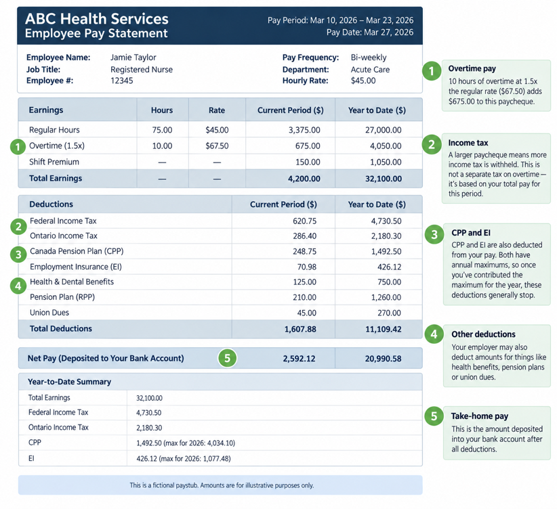
There’s no special overtime tax rate in Canada. The Canada Revenue Agency (CRA) treats overtime as employment income, taxing along with everything else you earn from your job. That means your employer will generally deduct income tax, Canada Pension Plan (CPP) contributions and Employment Insurance (EI) premiums from your overtime pay, just as they do from your regular pay.
If overtime is included in your normal paycheque, it will usually be added to your regular wages and deductions will be calculated on the total. If your overtime is paid later, it can work a little differently. The important thing to know is it’s still part of your employment income for the year.
“If overtime pushes part of your income into a higher bracket, only that extra portion is taxed at the higher rate—not your whole salary.”
How does overtime get taxed
Overtime is taxed the same as your other income, although your pay stub might give the impression it gets taxed differently. That’s because of the way income tax in Canada works. In Ontario, you pay both federal and provincial income tax, and different rates apply to different portions of your taxable income.
A tax bracket is an income range with a particular tax rate. If overtime pushes you into the next bracket, only the portion of your income that falls within that bracket is taxed at the higher rate—not your entire income.
For example, the first tax bracket—$58,523 of taxable income in 2026—is taxed at the lowest federal rate of 14%. Income from $58,523 to $117,045 (the next tax bracket) is taxed federally at 20.5%. Ontario uses its own brackets.
Example: A nurse picks up extra shifts
Say an Ontario registered nurse earns $80,000 before overtime and picks up another $10,000 worth of shifts. Their employment income is now $90,000.
Some of the extra income may all within a higher tax bracket, but not the whole $90,000. So, the nurse still takes home more money from their extra shifts.
The CRA has a handy explanation of how tax brackets work.
Why can the deductions look so high?
The deductions coming off your pay is your employer holding money back from your income to pay the CRA your expected income tax and other amounts. In terms of how this looks on your paycheque when you are due overtime, your employer deducts income tax from each paycheque based on how much you’re being paid. When overtime makes your paycheque larger than usual, you might amount of income tax withheld can also jump.
Remember that the tax deducted from one or two paycheque with overtime isn’t your final tax bill. Your actual income tax is based on your taxable income for the whole year. The amounts withheld from your paycheques go toward that final bill. Because these withheld amounts on each paycheque are expected deductibles, when it comes to your final bill you might be due a tax refund or have to pay extra.
CPP and EI deductions may also come off your overtime pay until you’ve contributed the maximum for the year.
The CRA’s Payroll Deductions Online Calculator (PDOC) can help you estimate your deductions.
Budget around your regular income—not your best month
For a whole range of professions—from firefighters and paramedics to police officers and tradespeople—overtime can make your monthly income variable. This can make budgeting a challenge.
The important thing is not to rely on that overtime for mortgage payments, regular expenses, your car payment, etc. Instead, try to build your everyday budget around your expected earnings without those extra shifts. If you base your budget around your regular income plus overtime, you can quickly get into trouble if the overtime dries up.
Example: Don’t make overtime part of the car payment
An electrician normally takes home $5,000 a month. Over the past year, overtime on a big project has boosted their income by $1,200 a month. Suddenly, that new truck seems affordable.
What if the current project wraps up and overtime falls to $300 a month—or even zero? By basing truck payments, along with other fixed costs, on the original $5,000 the electrician leaves that overtime available for savings, debt, travel and other money goals.
“The important thing is to decide where your extra money is best spent, saved or invested before it gets eaten up by that month’s spending.”
What should you do with extra pay?
Assuming you follow the advice above, what should you do with your overtime? One approach is to “pay yourself first”—an idea that can apply to all of your income. Basically, it means giving some of the money landing in your bank account a job before it gets spent on purchases, groceries, trips, etc. For example, you could:
Build or top up an emergency fund: It’s recommended to try to save three to six months of everyday expenses for emergencies, such as a job loss or income reduction, an unexpected health issue and other events you haven’t budgeted for.
Pay down some debt: If you have a high-interest credit card debt, another good option is to pay some of it down to save money in interest.
Put some extra money into an FHSA, TFSA or RRSP: It never hurts to boost your savings toward a home, retirement or other longer-term goal.
Save for something you know is coming: You may have a big expense in your near future, like home renovations or a bit trip.
Example: What could you do with an extra $800?
A paramedic has a busy month and brings home an extra $800 from overtime. They decide in advance to put:
- $300 into their emergency fund
- $250 into paying down credit card debt
- $150 into their TFSA
- $100 into an everyday spending account
The important thing is to decide where your extra money is best spent, saved or invested before it gets eaten up by that month’s spending. You can also automate these payments so the money you see in your everyday account is the money you have to spend that month.
Next steps: Make your overtime work harder
If overtime or other variable pay is part of your job, consider separating your regular, predictable income from the extra money. Use the money you can rely on to cover everyday expenses and treat overtime as a bonus you get to use in a variety of ways.
One month, you might put it toward getting rid of a credit card balance that never seems to reduce. Another could be an FHSA contribution to try to reach your home ownership dream sooner. Sometimes you might just decide to treat yourself and spend it to get a more immediate reward for working all those extra hours.
The main takeaway is to not just let your overtime get consumed by your monthly spending before considering if there’s a better way to use it.
Common questions about overtime pay
Is overtime taxed at a different rate in Canada?
No. Overtime is taxed the same as other employment income at a federal and provincial level.
Can overtime put me into a higher tax bracket?
Potentially. Overtime could cause your income to fall into a higher tax bracket. However, only that portion of your income may be taxed at the higher rate—not all of your income.
Why do my deductions seem so much higher?
A bigger paycheque can mean you owe more income tax, which is withheld from your pay by your employer and shows up as a deduction. However, your final tax bill is based on your total annual income, not individual paycheques that may or may not include overtime.
Do I pay CPP and EI on overtime?
Generally, yes. Overtime, like the rest of your income, is normally subject to CPP and EI deductions until you reach your annual maximum.